
Entering the Same Water: Jesus’ Baptism and the Meaning of Belonging
A reflection for the Baptism of the Lord Matthew 3:13–17
There is something quietly radical about where Jesus begins.
Jesus does not begin on a throne.He does not begin in the Temple.He does not begin by teaching, healing, or confronting power.
He begins by stepping into the same water as everyone else.
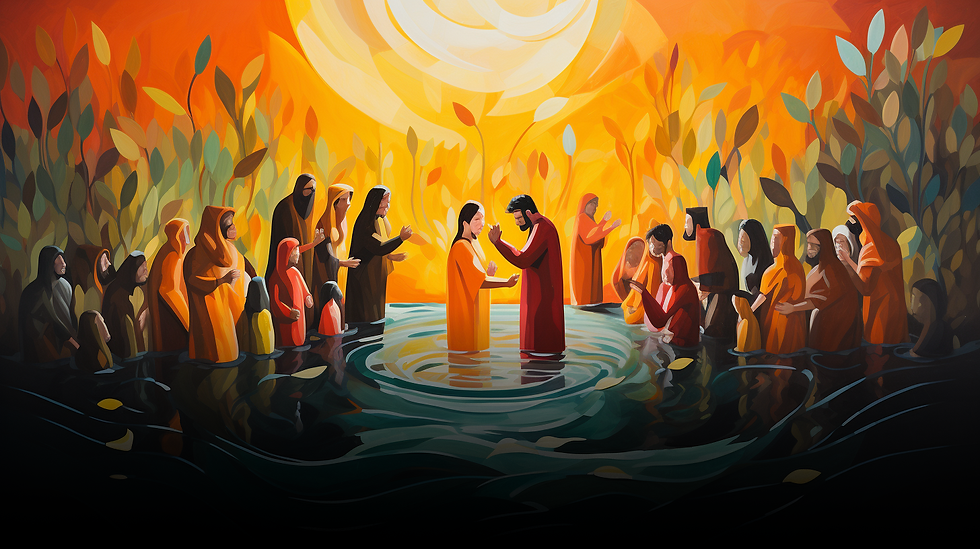
Matthew tells the story simply. Jesus comes from Galilee to the Jordan, where John is baptising. John resists. He knows the logic of hierarchy: I should be baptised by you. Jesus refuses that logic. “Let it be so now,” he says, “for it is proper for us to fulfil all righteousness.”
And then he enters the water.
The water already had a meaning
In Matthew 3, on the feast we call the Baptism of the Lord, this detail is not incidental. For Matthew’s first readers, the meaning of this water would have been immediately recognisable.
For Matthew’s audience, this moment would not have felt abstract or symbolic in the way it sometimes does for us. They knew exactly what kind of water this was.
John’s baptism stands firmly within Jewish tradition. Ritual immersion was a normal, embodied part of religious life. People immersed themselves for many reasons: after menstruation, before certain religious acts, when moving from one state of life to another. This immersion took place in a mikveh — a pool or body of “living water,” sometimes purpose-built, sometimes a natural river or spring.
The mikveh was not about hygiene. It was not a bath. It was about transition. About moving from one state to another. About re-entering community life. About readiness to encounter God.
John intensifies that tradition. He calls people to repentance — not as private guilt, but as a public turning. His baptism is not about shame. It is about preparation. A way of saying: something is coming, and we are not yet aligned with it.
That is the water Jesus steps into.
Jesus does not bypass the ritual
This matters.
Jesus does not reject the practice as outdated or oppressive.He does not spiritualise it away.He does not invent something new on the spot.
He submits to it.
And more than that — he asks permission.
Matthew is the only Gospel that records this moment of dialogue. Jesus does not seize the rite. He receives it. He places himself within relationship, within human agency, within tradition. This is not domination. It is consent, humility, participation.
In doing so, Jesus affirms the importance of physical practices and material signs in the life of faith. God does not work apart from the created world, but through it. Water, bodies, and actions are not symbols pointing elsewhere; they are the very means through which grace is encountered.
Whatever else “fulfilling all righteousness” means, it does not mean bypassing human processes in the name of divine exception.
Beloved is not a technical word
When Jesus comes up from the water, the heavens open. The Spirit descends. And a voice speaks:
“This is my Son, the Beloved, with whom I am well pleased.”
We often hear that word — beloved — as theological shorthand. But it is not technical language. It is not a doctrinal category. It is a word of affection.
In Greek, the word is agapētos. It means dearly loved, cherished, the one I delight in. It is the kind of word used in families, not law courts. It is relational language, not institutional language.
Matthew’s Jewish audience would have heard something even deeper. “Beloved” is language long used for Israel itself — for example, in passages like Isaiah 43, where God names Israel as precious and loved before rescue or obedience is demanded. God’s chosen people. God’s cherished community. By applying that word to Jesus, Matthew is not narrowing belonging — he is concentrating it. Jesus embodies what Israel was always called to be.
Belovedness is not being handed to Jesus as a reward. It is being named as truth.
And crucially, it is named before Jesus does anything publicly impressive.
Beloved before becoming
This is the theological heart of the story.
This is where the baptism of Jesus and our own baptism are best held together.
In both cases, baptism does not create a new reality; it reveals what is already true.
Jesus does not need baptism for repentance. He is not being cleansed. He is not being initiated into a faith he does not yet belong to. His baptism reveals what has always been true: that he is God’s Son, beloved, and aligned with the life of God.
Our baptism works in the same way, though the revelation is different. It reveals to us what God already knows — that we are already found in Christ, already held within the divine life, already sharing in the life of the One through whom all creation is made.
Same movement. Same purpose. Different unveiling.
Baptism does not change God’s relationship to us; it changes our awareness, our formation, and our willingness to live from what is already true.
That distinction matters, because it protects baptism from becoming a performance marker or a gateway to belonging. Baptism does not make us beloved; it teaches us to live as those who already are.
The pattern is this: identity precedes action.
We are not beloved because we are faithful.We are faithful because we are beloved.
A shift from repetition to beginning
As outlined earlier in the account of the mikveh and John’s baptism, this moment marks a change in how ritual washing is understood — not abandoned, but transformed.
Something else important happens here — something easy to miss.
Judaism retained repeated ritual immersions. Christianity did not.
Very early, the Church understands baptism not as a recurring cleansing, but as a once-for-all beginning. That is a profound shift, and it happens quickly.
Why?
Because baptism is not a repeated return to ritual purity.It is a once-for-all unveiling of identity in Christ — and the ongoing life of repentance is carried through confession, forgiveness, and shared discipleship, not repeated washings.
You do not keep returning to the moment of your birth.You live from it.
Christian life still involves repentance, confession, and transformation — but not through repeated washings. Baptism becomes the grounding truth that makes all of that possible without fear.
You do not need to keep proving you belong.
The same water, not a special queue
One detail in Matthew’s account is easy to overlook: Jesus joins the crowd.
There is no private ceremony. No reserved space. No spiritual fast-track.
He stands where others stand. He enters the water they have entered. He does not float above it. He does not purify it by avoidance. He sanctifies it by presence.
In a world obsessed with sorting — worthy and unworthy, insider and outsider, pure and impure — this is a quiet act of resistance.
Holiness is not separation.Righteousness is not exemption.God’s way is solidarity.
Baptism - What this means now
For the Church and for communities of faith today, to be baptised into Christ is not to be lifted out of the world’s waters, but to learn how to live within them without fear.
It means we stop treating belonging as something to be earned or defended. It means we resist systems — religious or political — that trade in purity, hierarchy, and exclusion. It means we learn to stand with others rather than above them.
And perhaps most importantly, it means we learn to hear that same word spoken over us:
Beloved.
Not when we get it right.Not when we are certain.Not when we are strong.
But as we are.
Before the wilderness.Before the work.Before the cost.
Jesus enters the water first — not to escape humanity, but to claim it.
And in doing so, he shows us that God’s voice does not wait for perfection. It speaks at the beginning.
Beloved.


Comments